
Brown Family Tree - Person Sheet
Brown Family Tree - Person Sheet
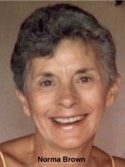
NameNorma Mae Buskey 
 , F
, F
, FBirth Date18 Aug 1928
Birth PlaceYoungwood, PA
Death Date15 Jun 2007 Age: 78
Death PlacePhoenix, AZ
OccupationUnited Steel Workers CO, Youngwood, PA
EducationYoungwood High School, 1946
FatherJohn Edwin Buskey , M (1901-1938)
MotherDelta Arena Roadman , F (1899-1993)
Spouses

1John "Jack" Morgan Brown , Uncle, M
, Uncle, MBirth Date4 Jul 1925
Birth PlaceYoungwood, PA
Death Date4 May 2002 Age: 76
Death PlacePhoenix, AZ
MemoDied of cancer. Private ceremony at Veterans Cemetary in Phoenix.
Burial Date10 May 2002
Burial PlaceNational Memorial Cemetery, Phoenix, AZ
Military ServiceWorld War II, US Marines, joined 29 June 1943, trained at Parris Island, SC. Discharged 28 Feb 1946. Corporal
FatherGeorge “Curt” Curtis Brown , M (1894-1977)
MotherFlorence Morgan , F (1896-1997)
Marr Date15 Apr 1949
Marr PlaceYoungwood, PA, Methodist Church
Marr MemoRev. J.H. MacRill
ChildrenVicki Lynn , F (1959-)
Julie Ann , F (1969-)
Notes for Norma Mae Buskey
Norma Buskey Brown-Census Records
Based on information from the 1930 United States Federal Census
The 1930 United States Federal Census records Norma Buskey living in Youngwood, Westmoreland County, Pennsylvania. At the time, Norma was approximately one year old and resided with her family on South Third Street. Her father, John E. Buskey, was listed as the head of the household, and her mother, Delta Buskey, was recorded as the wife. Norma was the youngest of three daughters, all of whom were born in Pennsylvania. The census captures a snapshot of a typical American family during the early years of the Great Depression, offering insights into family structure and living arrangements during a period of significant economic hardship.
Norma's birth year is given as circa 1929, aligning with the challenging era of the late 1920s and early 1930s in the United States. During this time, many families faced economic uncertainty, but the Buskey family maintained their household in Youngwood, a community situated in a county known for its industrial and agricultural activities. This census record provides a glimpse into the demographic and social landscape of Pennsylvania families during the Great Depression, illustrating the resilience and continuity of daily life amidst broader economic struggles.
Based on information from the 1940 United States Federal Census
The 1940 United States Federal Census record for Norma Buskey captures a snapshot of her life as an 11-year-old residing in Youngwood, Westmoreland, Pennsylvania. She lived in a household with her mother, Delta Buskey, and siblings, Gwendolyn and Juanita. The census notes Norma as a daughter in the family, highlighting her education status as she attended school at the time. The household also included a lodger, Edward Durschleg, indicating a common practice of taking in boarders for additional income during this period.
This census provides valuable insights into family structures and living arrangements in the early 20th century. It reflects broader social and economic trends, such as the importance of education and the economic strategies families employed, including taking in lodgers. This context is vital for understanding the social fabric of American communities during the 1940s.
Based on information from the 1950 United States Federal Census
The 1950 United States Federal Census record for Norma M Brown shows her as a 21-year-old married woman living in Youngstown, Westmoreland, Pennsylvania. According to the census, she was residing on South 4th Street, Apartment 26, with her husband, John M Brown, who was the head of the household. Norma's occupation was listed as "Keeping House," and she was not working, seeking work, or employed outside the home at the time. This record provides a snapshot of life in post-war America, illustrating the domestic roles often held by women during this era.
Based on information from the 1930 United States Federal Census
The 1930 United States Federal Census records Norma Buskey living in Youngwood, Westmoreland County, Pennsylvania. At the time, Norma was approximately one year old and resided with her family on South Third Street. Her father, John E. Buskey, was listed as the head of the household, and her mother, Delta Buskey, was recorded as the wife. Norma was the youngest of three daughters, all of whom were born in Pennsylvania. The census captures a snapshot of a typical American family during the early years of the Great Depression, offering insights into family structure and living arrangements during a period of significant economic hardship.
Norma's birth year is given as circa 1929, aligning with the challenging era of the late 1920s and early 1930s in the United States. During this time, many families faced economic uncertainty, but the Buskey family maintained their household in Youngwood, a community situated in a county known for its industrial and agricultural activities. This census record provides a glimpse into the demographic and social landscape of Pennsylvania families during the Great Depression, illustrating the resilience and continuity of daily life amidst broader economic struggles.
Based on information from the 1940 United States Federal Census
The 1940 United States Federal Census record for Norma Buskey captures a snapshot of her life as an 11-year-old residing in Youngwood, Westmoreland, Pennsylvania. She lived in a household with her mother, Delta Buskey, and siblings, Gwendolyn and Juanita. The census notes Norma as a daughter in the family, highlighting her education status as she attended school at the time. The household also included a lodger, Edward Durschleg, indicating a common practice of taking in boarders for additional income during this period.
This census provides valuable insights into family structures and living arrangements in the early 20th century. It reflects broader social and economic trends, such as the importance of education and the economic strategies families employed, including taking in lodgers. This context is vital for understanding the social fabric of American communities during the 1940s.
Based on information from the 1950 United States Federal Census
The 1950 United States Federal Census record for Norma M Brown shows her as a 21-year-old married woman living in Youngstown, Westmoreland, Pennsylvania. According to the census, she was residing on South 4th Street, Apartment 26, with her husband, John M Brown, who was the head of the household. Norma's occupation was listed as "Keeping House," and she was not working, seeking work, or employed outside the home at the time. This record provides a snapshot of life in post-war America, illustrating the domestic roles often held by women during this era.
Notes for John "Jack" Morgan (Spouse 1)
Jack Morgan Brown-Census Records
Based on information from the 1930 United States Federal Census
The 1930 United States Federal Census record for Jack Brown, age 4, lists him as residing in Youngwood, Westmoreland, Pennsylvania. Jack is identified as the son of George C. Brown and Florence Brown. The census indicates that Jack was born in Pennsylvania around 1926. He lived with his family on North Fifth Street, and the household included his brother, Dale Brown. This record provides a snapshot of Jack's early life in a small Pennsylvania town during the Great Depression, a period marked by economic challenges and changes in family life across the United States.
Based on information from the 1940 United States Federal Census
The 1940 United States Federal Census record for Jack M. Brown provides a snapshot of his life at the time. At age 14, he lived in Youngwood, Westmoreland County, Pennsylvania, with his family, including his parents, George C. Brown, aged 46, and Florence Brown, aged 44, and his older brother, Dale A. Brown, aged 16. The record notes that Jack was attending school and had completed the 8th grade. He was not employed, as indicated by his income and weeks worked, both listed as zero. The family resided at 106 N-5th Street, remaining in the same community since at least 1935.
This record offers a glimpse into family life during the late Great Depression era, highlighting how many American families, like the Browns, relied on education as a means of future economic mobility. The census reflects broader social trends of the time, including the impact of economic conditions on employment and family stability.
Based on information from the 1950 United States Federal Census
The 1950 United States Federal Census record for John M. Brown provides a snapshot of his life at that time. John M. Brown, aged 24, was living in Youngstown, Westmoreland County, Pennsylvania, with his wife, Norma M. Brown, who was 21. John was identified as the head of the household, and his occupation was listed as a manager in a retail grocery store, indicating he owned the business. The record notes that he worked 96 hours during the census week, highlighting the demands of his job.
This census entry is part of a larger effort to document the American population in the post-World War II era, capturing details of occupation, residence, and family structure. The record situates John M. Brown within the broader social and economic context of the 1950s, a time characterized by economic growth and the expansion of suburban life in the United States.
Based on information from the 1930 United States Federal Census
The 1930 United States Federal Census record for Jack Brown, age 4, lists him as residing in Youngwood, Westmoreland, Pennsylvania. Jack is identified as the son of George C. Brown and Florence Brown. The census indicates that Jack was born in Pennsylvania around 1926. He lived with his family on North Fifth Street, and the household included his brother, Dale Brown. This record provides a snapshot of Jack's early life in a small Pennsylvania town during the Great Depression, a period marked by economic challenges and changes in family life across the United States.
Based on information from the 1940 United States Federal Census
The 1940 United States Federal Census record for Jack M. Brown provides a snapshot of his life at the time. At age 14, he lived in Youngwood, Westmoreland County, Pennsylvania, with his family, including his parents, George C. Brown, aged 46, and Florence Brown, aged 44, and his older brother, Dale A. Brown, aged 16. The record notes that Jack was attending school and had completed the 8th grade. He was not employed, as indicated by his income and weeks worked, both listed as zero. The family resided at 106 N-5th Street, remaining in the same community since at least 1935.
This record offers a glimpse into family life during the late Great Depression era, highlighting how many American families, like the Browns, relied on education as a means of future economic mobility. The census reflects broader social trends of the time, including the impact of economic conditions on employment and family stability.
Based on information from the 1950 United States Federal Census
The 1950 United States Federal Census record for John M. Brown provides a snapshot of his life at that time. John M. Brown, aged 24, was living in Youngstown, Westmoreland County, Pennsylvania, with his wife, Norma M. Brown, who was 21. John was identified as the head of the household, and his occupation was listed as a manager in a retail grocery store, indicating he owned the business. The record notes that he worked 96 hours during the census week, highlighting the demands of his job.
This census entry is part of a larger effort to document the American population in the post-World War II era, capturing details of occupation, residence, and family structure. The record situates John M. Brown within the broader social and economic context of the 1950s, a time characterized by economic growth and the expansion of suburban life in the United States.